

This is where members’ stories of their experiences at NAL can be shared with other members.
Just send your story, true or imagined, to nalites2022@gmail.com
A photograph of a young John Macrae being a subject in an experiment run by Dick Waugh. Dick generated 90dBA of white noise in a test room to evaluate the effectiveness of foam earplugs.
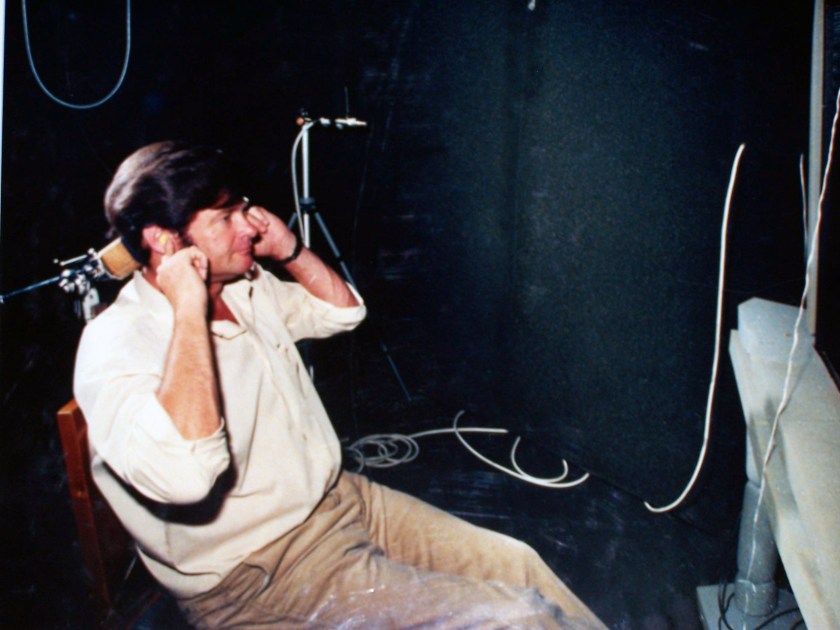
John recalls, “These earplugs were a new development at the time and Dick asked me to point to the earplugs for the photo”.
“I don’t know the exact date when the photo was taken. I copied it into my Pictures folder in 2003. It was taken not long after we had moved to Hickson Road, perhaps in the mid-1960s.”
“A celebration of sound – The history of Hearing Australia”
Extracted from the publication to commemorate 75 years of “Hearing Australia”.
The full story can be read here.
This is where the story of the Calaid began.
Why was the Calaid invented?
The Calaid was invented because Australian health authorities were faced with two new and quite distinct groups of people who were hard of hearing following the Second World War: Ex-service personnel and young children affected by the rubella epidemic in Australia (1939-1941). Typically, these children suffered profound hearing loss, with little or no speech. Their parents, who had normal speech and language, wanted their children to grow up being able to experience sound. With no existing model anywhere in the world to manage the hearing problems presented by these ex-service personnel and young children, the Commonwealth Acoustic Laboratories (CAL), was born.
Initially, we imported hearing aids from the USA. However, the expense of repairing parts and the cost of the US dollar demanded a new solution. It was decided hearing aids would be designed and manufactured in Australia, by CAL. This is where the story of the Calaid began.
The Calaid: models and milestones.
Calaid Type 1 was a body-worn type with a button earphone attached
by a cord. It came with two controls, a tone switch and a volume control.
The Calaid T was launched in 1955. It was a smaller body-worn hearing
aid with a more efficient amplifier.
The Calaid E — Australia’s first in-the-ear hearing aid was launched in 1965. It was less powerful than the bodyworn aids so was best suited to people with milder hearing loss looking for a more discreet hearing aid. 75% of all hearing aids fitted at this time were Calaid E.
The Calaid C and Calaid G were a new range of body-worn aids to replace the Calaid T. They had a plastic frame, which held the electronics and battery.
The Calaid H – Australia’s first behind-the-ear hearing aid launched in 1974 and was Australia’s first behind-the-ear hearing aid. It was made in three
power ranges and included a choice of two microphones.
The Calaid P launched a few years later. It was another behind-the-ear hearing aid but it was high powered and best suited to people with severe or profound hearing loss.
Calaid V In 1982 we released the Calaid V, which was a new improved behind-the-ear range of hearing aids.
Calaid FM Wireless. The Calaid FM Wireless System, launched in 1983, was a short-range system that coupled to conventional hearing aids. It was hailed as a world leader in its field. Developed by NAL and CSIRO, the final production and design was undertaken by Plessy Australia.
The Calaid J was a new in-the-ear hearing aid introduced in 1991. It was given the marketing name SONATA.
Digital hearing aids.
While our first digital hearing aids, introduced in the early 1990s, heralded the beginning of a new era in hearing aids, the Calaid will always be remembered as playing a significant part of Australia’s hearing health and acoustic history.
 NALites